Thursday, 10 July 2014

Robben Island: A pilgrimage for Nelson Mandela

When you think of South Africa, you think of Nelson Mandela, the country's first black president, someone who fought against apartheid and was jailed for his belief that blacks and whites should be equal in his country. And then you think of Cape Town and you think of Robben Island, the island where Mandela and so many other political prisoners were held. Having just finished reading 'Long Walk to Freedom' on my 18 hour bus journey from Windhoek, I was eager to visit this place that Mandela started his autobiography and the place where he spent most of his adult life.

Having read a lot about visiting Robben Island, not all good, I was not expecting much. Having read about being rushed around the island and not having time to explore, I still wanted to visit this place shrouded in so much history. I had visited the Nelson Mandela Gateway at the V&A Waterfront at enquired about availability. The horror stories about week long waits for tickets were false and I was there during the summer in February and could have left that afternoon if I wanted. Granted, if you were a larger group then you may have to wait a day or 2 (and in Cape Town, that is no hard thing, read about it here) but as I was looking for 2 tickets, it was very straightforward. I paid R500 for the 2 tickets (approx USD50) for an 11am sailing. Ferries run at 9am, 11am, 1pm and 3pm daily and it's recommended you are at the Gateway 30mins prior to departure. Realistically there are 2 boats that go across at the time and you could be on either. TIP: Try to get there earlier and get the first boat as then you can look around a bit before going to the prison for your tour.

As a result of  going through some fog en route. 
Robben Island is about 9km off the coast of Cape Town and was used as a metal health asylum and as a leper colony in previous times. It is most well known for having been the site of internment of South Africa's political prisoners during the apartheid regime and served as a maximum security prison until 1991. The boat trip over was all part of the experience. Seeing the seals that gave Robben Island it's name swimming next to the boat and the island being shrouded in a low lying fog giving an eerie, and damp, trip into the harbour.
Our guide giving the ANC salute

The tours are run by former inmates and the inmate running our tour was arrested as part of the Soweto uprising and was housed in the D block. He talked of his experience in the prison and of the strong solidarity among the political prisoners, something that Mandela touches on in "The Long Walk to Freedom". Touring the prison grounds, seeing censored letters and the famous garden where the first draft of Mandela's autobiography was hidden and getting a chance to peek into that famous cell, adorned with a wreath and a memorial candle, all added to the poignancy of the day. Yes, you are herded around in a big group, yes there is not much time to explore on your own and yes, it can be irritating if you are used to slow exploring but these reasons are not enough to warrant you passing up this opportunity. Having read the book, and seen the mild undercurrent of racism that still exists in South Africa, and indeed all across the globe, it gives you a strong feeling of what these people were fighting for. They were fighting to be considered as equals, to be given the basic human rights that the white people were given. Simple things like interracial relationships were illegal under apartheid, black people were only allowed live in certain areas and in the case of District Six, were force ably removed if the area was reallocated to a different racial group. Education, welfare, even park benches were segregated. Mandela talks about how this segregation even continued within the prison walls with differing uniforms and food for White, Blacks and Coloureds.
Mandela's cell

The garden where the first draft of
'Long Walk to Freedom' was hidden.
Cell block D


Following the tour of the prison we boarded buses to travel around the small island seeing the lime quarry where Mandela and his fellow inmates conducted their physical labour and held meetings and taught fellow inmates, stopping off to admire Cape Town with the majestic Table Mountain towering over the city. A sight that was so near but yet so far for the inmates. A view that tempted more than one inmate to attempt to swim to the mainland. Once again the guide on our bus was fantastic giving insights and facts about apartheid, even going so far as to explain to the whole bus that if Puncque and I had been together during apartheid, we would have been breaking the law!
Under apartheid laws this would have been illegal


Rows of letters between the
 Irish government
and the Irish Anti Apartheid movement
Coming back to the mainland we took some time to walk around the museum at the Gateway. For me, there was a huge surge of pride as we wandered around an exhibition on the Irish Anti Apartheid Movement. To feel that my little country on the edge of Europe had a role to play in the anti apartheid movement. From the brave 10 women and one man who picketed Dunnes Stores for nearly 3 years when they refused to handle South African goods, to Nelson Mandela being given the freedom of Dublin city and him choosing Ireland as his first European country to visit after his release.


Mandela receiving the freedom of Dublin in 1990
At the end of the day, when you attend a major tourist attraction be it Robben Island, Ankor Wat, the Louvre or Maccu Picchu you will battle with crowds, you will have the things you are allowed to do dictated by the people who run that attraction. Is this a reason not to visit it? Not at all. If you miss out on these places you will be missing out on a piece of history, an amazing sight or an experience of a life time.


NOTE: Today I went to the world premiere of Blood Fruit, a documentary about the Dunnes Stores strikers and their role in the Irish anti apartheid movement. It was an amazing story that finished with a letter from Archbishop Desmond Tutu congratulating all involved in the making of the documentary.

QUOTE FOR THE DAY: "Certainly, travel is more than the seeing of sights; it is a change that goes on, deep and permanent, in the ideas of living." Miriam Beard

Thursday, 5 June 2014

Throw Back Thursday: Inca Trail

On my first trip abroad in 2011, I went exploring in South America and of course a highlight was hiking the Inca Trail to see the sun rise over Machu Picchu in Peru.

To hike the Inca trail you need to do so as part of an organised tour and book permits in advance. As I was going to be traveling with Gap (now G) Adventures as part of a longer trip, this was all organised for me. Now fear not, if you still want to hike to Machu Picchu but did not secure one of the Inca Trail passes there are other options including the Lares trek and even in Cusco you will be offered treks walking around the square. It is also possible to visit Machu Picchu via train and bus from Aguas Calientes without the multiple days hiking!

So what is Machu Picchu and why does it draw people to it? Machu Picchu is an Incan site believed to have been built in 1450 and abandoned a century later when the Incans heard of the Spanish invading. However the Spanish never made it as far into the Sacred Valley as Machu Picchu and as such the abandoned site was left to nature and became overgrown. It was discovered by Hiram Binghan in the early 1900s and was remarkably well preserved due to no army coming in and knocking it down I guess!

The Inca Trail, and indeed Machu Picchu, lie at what is considered high altitude and to minimise the risk of altitude sickness it is advised that you spend 2-3 days at altitude prior to starting the treck. This can be done in Cusco, or in my case spend nearly 2 weeks at altitude travelling through Bolivia.

Our group at the start
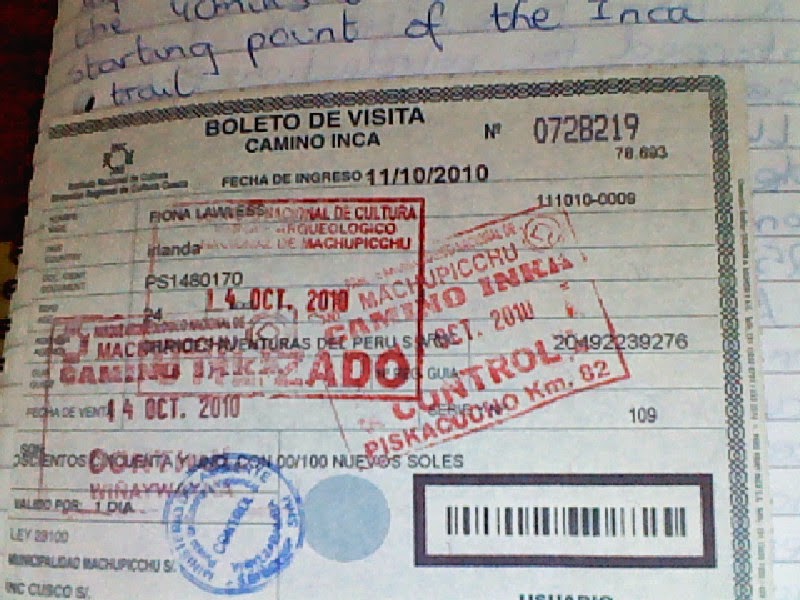
Anyway, we started our trip in Ollantaytambo which is about a 40mins drive from the starting point of the Inca trail, Km82 where we met our 17 porters and after passing through passport control and showing our permits, we were off. The permits need to be kept onto and stamped at each campsite
Dinner time
Day one was relatively easy, a 12km hike through farmland and relatively flat. We stopped at one point to view an Incan ruin, Llactapata, and our 17 porters trotted past us having packed all of our stuff and carrying 25kg each on their backs. Our group arrived as the first group to the camp as we decided to press through and not stop for lunch. This turned out to be a great idea as we got to camp by 1pm and so had lunch, learnt there was a villager nearby who sold twixes and played many games of Presidents and Assholes which was to become the game of choice for the hike. As the other teams were arriving, the skies opened and we all remarked on how glad we were that we were playing our 10th round of cards and not walking in the rain. That night we camped at 3,300m. 
All of us with guides, porters and chefs
At Dead Woman's Pass
View from the campsite on the
second night


It was an early start the next day for a 9km uphill portion to the infamous Dead Woman's Pass, called so because it looks like a woman lying down, which is at 4,215m. A snack was served at 3,800m asl and at this stage the altitude was starting to get noticable, breathing was more difficult, simply walking to the toilet caused you to get out of breath. The uphill portion was pretty much steps the whole way which is a killer on the knees and you really have to just take it at your own pace. Luckily the second guide Miguel stayed at the back with Sam, Bex and I and kept encouraging us. On reaching Dead Woman's Pass, the three of us celebrated with those infamous twix bars before starting off for the 4km downhill stretch to the next camp. Here I powered down with the thought of a hot mug of tea and some quinoa soup on my mind. As with the day before I received high fives from the porters who passed me out in the first hour and arrived hours before to set up our camp. At this point some groups continued on the cross the next peak the same day and I cannot imagine how they managed it. After admiring the view from our tent and layering up as it was getting really cold once the sun went down (3,600m asl), it was cards and dinner time while all thinking about the peak we had to tackle first thing in the morning. The highlight of dinner was the below cake. Who would expect a cake on the Inca Trail.

And food got better the next morning with pancakes with the porters names written on in dulche de leche. Personally I enjoyed the third day the most, there are more ruins to explore and you get lower in altitude, into rainforest territory so the views and the surroundings were gorgeous. This day was the longest, 16km in total, with 2 high passes to cross but honestly after the Dead Woman's Pass, I was ready for anything. It was tough and as we started to get lower it altitude, it got hot and sweaty but the views, the sounds and the promise of a shower at the campsite that night kept us all going. We explored two ruins and walked through rainforests before arriving at a ruin that overlooks the Sacred Valley to talk about our last day. It seemed fitting that we could view the Willkamayu river which means Sacred Valley in Quechua as we discussed our final leg to the Sun Gate and finally seeing Maccu Pichu. That night we presented our tips to the porters as they would not be continuing into Maccu Pichu with us, the oldest of our porters was 55 and the youngest was 18. Some music, dancing and clapping made it a very festive occasion. An early night was had by all as we were waking at 3:30 to be at the control gate when it opened and to hopefully make it to the Sun Gate by sunrise. 
View over the Sacred Valley
At the first peak for day 3


Waiting for the control gate to open


Finally, the Sun Gate
When the control gate was 15mins late opening, our group was getting a little tetchy as we all wanted to be at the Sun Gate for sunrise. We powered through and managed to make the, what should be, 90mins walk in 45mins. And boy was it worth we. we turned the corner to a beautiful panorama over Maccu Pichu and to had it pretty much to ourselves for about 30mins. As the sun was getting higher in the sky we could see it would be a perfect day, sunny and cloudless. Picture perfect for viewing the ruins. However, for a pasty Irish girl such as myself, there was a real risk of me frying so during our tour of the ruins, I could be found standing in any shade I could find. At one point I snuck underneath a rock outcrop to be in the only portion of shade in the old quarry area. 


You can spend hours, and indeed days, wandering around the ruins. Discovering places that you have all to yourself, climbing up and down terraces, wondering and exploring and imagining. Even turning corners to find llamas. It is truly a spectacle what the Incan empire managed to build and it makes one wonder that were it not for the Spanish Invasion and the addition of small pox, would Peru be a major player on the world scale? What this empire achieved with rudimentary tools is simply amazing. The fact that areas are still being uncovered and that this huge city was abandoned and lay, unknown, for thousands of years is mindboggling. 

Is it worth it? Most definitely. The sense of achievement on making it to the Sun Gate after 3 long trekking days was immense. We all felt we had earned the right to explore the ruins, to take it all in. The friendships I made on this trek are ones I will remember forever, even being invited to Sam and Bex's wedding, a tad different to sharing a twix at Dead Woman's Pass. Machu Piccu, while very touristic, is one of those 'must-see' sights. The ruins are so big that we were often alone exploring and at times you felt like you were the only person around. 

Tuesday, 13 May 2014

Travel Tips: How to survive long distance bus journeys


At this stage I have taken more 12 hour+ bus journeys than I would care to admit, I've taken over night buses on 4 continents, 7 countries and have taken an impressive 22 hour bus from Windhoek (Namibia) to Cape Town (South Africa). However, my pinnacle of bus journeys has to be the 36 hour bus journey I took from Johannesburg (South Africa) to Blantyre (Malawi) that included all of the following: the bus arriving to Park Station 2 hours after it was supposed to LEAVE, broken air con 2 hours into the journey, 3 countries, 6 border posts, blatant corruption by Mozambican border officials, 4 hours at the Mwanza border in Malawi and half a block of cheese being our only food for 24 of those hours! Now, I by no mean claim to be an expert in bus travel but I have found things that work for me on these long journeys.


Have a buddy
If at all possible travel with a friend. This has multiple benefits including being able to sleep on their shoulder and having someone watch your stuff while you run off the bus to pee on the side of the road (African buses of course). Now if you are like me and often travel solo this is a real treat to have company on a long bus journey.

Have a good book. 
Anything that will grip you and make you feel like minutes have passed instead of hours. I find my kindle invaluable in this instance as, if I am finding a book is dragging and not gripping me, I can change and make the hours fly by. (Note that in Argentina and Chile and South Africa they show movies on board some of the buses but sometimes they are not the type you would want to watch, think strong Christian beliefs in movies shown on the Intercape buses)

Snacks. 
Always take snacks. Argentinian and Chilean buses tend to give you meals on longer journeys (I got a hot dinner with wine and champage after dinner on my 18 hour bus from Buenos Aires to Iguazu Falls) but must buses don't. Often the stops are at fuel stations in the middle of no where with very limited (and expensive options). I usually take an apple, some nuts, a sandwich and a cereal bar with me and a BIG bottle of water. Never underestimate how dehydrating travel can be.

Make yourself comfortable
On long journeys comfort is important. If you are taking an overnight journey, you don't want to waste the whole day that you arrive being tired and cranky and just wanting to sleep! So I always bring a neck pillow (I have an inflatable one which takes up about as much room as some tissues), an eye mask (nothing worse than being woken up by someone's light/ an very early sunrise) and a blanket (when aircon does work, it can be super cold). I always try brush my teeth at the last stop before I think I'll fall asleep as it really puts me
into sleepy mode.

Dress not to impress
Comfort is key, not just in what you bring with you but in how you dress. Comfy clothes are required so elasticated waistbands are your answer, think yoga pants, tracksuit bottoms, cotton t-shirts. Always bring a cardigan (A/C again) and socks!

Late night the night before
This is a controversial one but if you are taking an over night bus that is not one of the amazing Argentinian ones, I would stay awake as much as possible the night before so that you are more likely to fall asleep the following night!

Let your imagination run wild
Am I the only one who makes up stories in my head on long journeys or while walking long distances? Yes. Oh well. I love to let my imagination run wild and think up stories involving the people around me or people I know who are far away or just how my day will turn out (this usually involves being whisked away to an amazing restaurant all expenses paid- yet to happen!)

At the end of the day any bus journey is worth it because when you get off, you are in a new place and get to explore. (Someone remind me of that when I'm on my next long journey)

Friday, 9 May 2014

Cape Town: The city that stole my heart

I am not over exaggerating when I say I fell in love with Cape Town, whether is was the bustling Waterfront, the weather or the cocktail happy hours, it is a city that stole my heart. Everyone I have spoken to who has been to Cape Town has had nothing but good things to say about the city and it lived up to the hype.

Cape Town has a perfect mix of outdoors and nightlife, things to do and places to lounge and I found myself staying there for longer than I had planned. It is a city I could easily live in with options of hiking, surfing and swimming a weekends but with cocktails, ostrich burgers and dancing for night time.
The infamous Tablecloth seen from the V&A
Waterfront

View up Platteklip Gorge
One of the draws in Cape Town is hiking Table Mountain. At over 1,000m high and nearly 3km across, it is a relatively straightforward climb with amazing views to reward you on reaching the summit. Megan and I decided to climb via Platteklip Gorge, one of the most straightforward ascents. We took a taxi for R50 to the base of the mountain but later found out that minibuses go to the turn off which would prevent you being ripped off by a taxi driver (ours tried initially to charge R80 and then turned off the meter before he stopped the car and tried to charge R60). We started the climb shortly after 10am and reached the summit shortly after 2:30. In places the trail is very exposed so take plenty of water and sunscreen if climbing in the summer season. Once you reach the top, there are many trails you can follow and there are views over the City Bowl and Atlantic Ocean on one side and down to Cape Point and the Indian Ocean on the other. We treated ourselves to a well earned ice-cream before taking the cable car back down.
View south along the Cape Peninsula
 from the top of Table Mountain

View of the City Bowl, Signal Hill and Robben
Island from Table Mountain


One day I took the Red tour bus which I always find a great way to orientate yourself and to get some historical nuggets. I hopped off to explore Kirstenbosch Botanical Gardens under the eastern side of Table Mountain. The Cape Peninsula is home to one of the floral kingdoms, the Cape Region of the South African Kingdom, the smallest of all the floral kingdoms and one of the iconic flowers of that kingdom is the King Protea, the national flower of South Africa. Unfortunately it seems I had just missed the flowering season but none the less Kirstenbosch provided some beautiful plants, and some interesting information it the natural medicine area.


The red bus took me out towards the wine area and Groot Constantia winery. Just a note for all the single gals among you, don't do what I did and go to Kirstenbosch and wine tasting on Valentine's day. I was surrounded by couples being all coupley and it just hit home that I was all alone on that day! 

After the stop at Groot Constantia, the bus made it's way out the to 'Republic' of Hout Bay and along the back of Table Mountain, under the shadow of the 12 apostles through Camps Bay and back to the V&A Waterfront. The views along this coastal portion are amazing, crashing waves, beautiful suburbs perched on cliff edges and with the sun setting behind me, it was a perfect end to the day. 


Along with all these good, clean outdoor activities, the hedonistic centre of Long Street awaits you in the evening. This place is busy every night of the week whether it is people meeting for dinners in one of the many restaurants (dining al fresco in the summer), having happy hour cocktails (how I spent my evenings) or dancing the night away, you have your pick of places. I stayed in Long Street Backpackers at the heart of Long Street and so was just steps away from it all but again Long Street is full of accommodation to suit all budgets with at least 4 other hostels on the same block as LSB alone. 


Cape Town has so much to offer that it's impossible to cover it all in one blog post. I mean I haven't even touched on Robben Island, the Cape of Good Hope etc